
Rugby Shoulder Injuries: Treatment, Rehabilitation and Returning to Play
23 July 2026
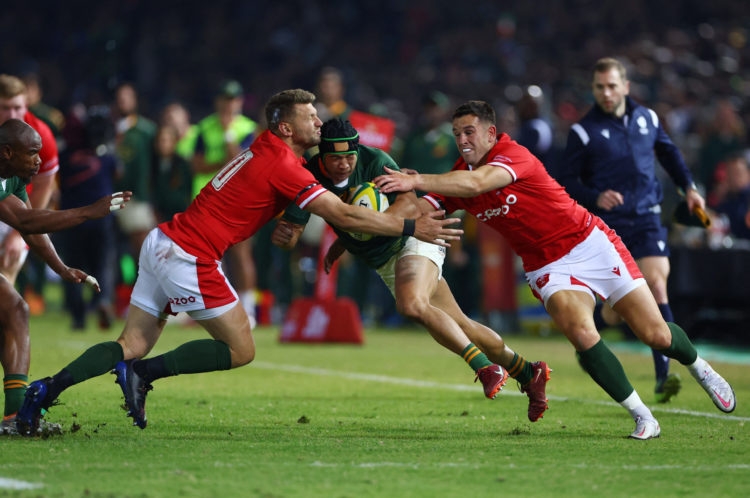
Shoulder injuries are common in rugby union because players repeatedly tackle, carry, fall, ruck and compete for the ball under significant physical pressure.
World Rugby reports that shoulder injuries account for approximately 20% of rugby injuries, making the shoulder the second most commonly injured joint after the knee. It also reports that around 35% of rugby shoulder injuries are recurrent, while the tackle is associated with almost half of all shoulder injuries.
These figures underline why rugby shoulder rehabilitation must do more than reduce pain. Players need to rebuild strength, stability, confidence and contact tolerance before safely returning to training or competition.
At TA Physiotherapy, we provide sports injury assessment and rugby rehabilitation across our clinics in Henley-on-Thames, Crouch End and Marylebone.
Why Are Shoulder Injuries So Common in Rugby?
The shoulder is highly mobile, but that mobility means it relies heavily on muscles, tendons, ligaments and joint structures for stability.
During rugby, the shoulder may be exposed to substantial force through:
- Tackling
- Being tackled
- Falling onto the arm or point of the shoulder
- Carrying into contact
- Rucking and mauling
- Scrummaging
- Reaching for the ball
- Repeated collisions
World Rugby identifies the tackle as the phase of play most strongly associated with shoulder injuries. Research involving schoolboy rugby union also found a shoulder match-injury incidence of 12.2 injuries per 1,000 playing hours, with an average of 47 days lost for each injury. Shoulder dislocations and subluxations accounted for 34% of the injuries studied, while acromioclavicular joint sprains accounted for 30%. (World Rugby Passport)
Common Rugby Shoulder Injuries
Shoulder dislocation and instability
A shoulder dislocation occurs when the ball at the top of the upper-arm bone is forced out of its socket. World Rugby states that approximately 95–98% of shoulder dislocations in rugby are anterior dislocations, where the joint moves forwards. (World Rugby Passport)
A player may experience:
- Sudden and severe shoulder pain
- An obvious change in the shape of the shoulder
- An inability to move the arm normally
- Tingling, numbness or weakness
- A feeling that the shoulder has slipped out
A suspected dislocation requires urgent professional assessment. Players, coaches and unqualified bystanders should not attempt to relocate the joint themselves.
Even after the shoulder has been relocated, the player may be left with instability, reduced strength and apprehension during tackling or overhead movements.
Acromioclavicular joint injuries
The acromioclavicular joint, commonly called the AC joint, sits at the top of the shoulder where the collarbone meets the shoulder blade.
An AC joint injury often occurs when a player lands directly on the point of the shoulder. Symptoms may include:
- Pain at the top of the shoulder
- Local swelling or bruising
- Pain when moving the arm across the body
- Difficulty tackling, lifting or sleeping on the affected side
- A visible prominence in more severe injuries
The severity can range from a relatively minor sprain to significant disruption of the supporting ligaments.
Rotator cuff injuries
The rotator cuff is a group of muscles and tendons that helps control and stabilise the shoulder.
Rugby players may develop rotator cuff pain following a direct collision, repeated tackling or a gradual increase in training load. Common symptoms include:
- Pain when raising the arm
- Weakness during pushing or pulling
- Pain when lying on the shoulder
- Reduced power in contact
- Discomfort during gym exercises
Not every rotator cuff injury is a tear. Many cases involve overload, irritation or reduced capacity and can respond well to progressive rehabilitation.
Labral injuries
The labrum is a rim of cartilage that helps deepen the shoulder socket. It can be injured during a dislocation, forceful tackle or awkward collision.
Possible symptoms include:
- Deep shoulder pain
- Clicking, catching or locking
- Instability or apprehension
- Reduced confidence in contact
- Pain during pressing or overhead movements
A significant traumatic labral injury may require specialist orthopaedic assessment, particularly where instability persists.
Fractures and more serious trauma
Direct collisions can occasionally cause fractures involving the collarbone, upper arm or shoulder blade.
Urgent medical assessment is needed following major trauma, visible deformity, severe pain, loss of sensation or an inability to move the arm.
What Should You Do After a Rugby Shoulder Injury?
The player should stop participating if there is significant pain, weakness, instability or loss of movement.
Continuing to tackle or play through a traumatic shoulder injury can worsen the damage and make recovery more complicated.
Seek urgent assessment when there is:
- An obvious deformity
- A suspected dislocation or fracture
- Numbness or tingling
- Loss of circulation
- Severe or worsening pain
- Inability to lift or move the arm
- Significant weakness following a collision
For less severe injuries, an early physiotherapy assessment can establish which structures may be involved and whether imaging or an orthopaedic opinion is appropriate.
How Does Rugby Shoulder Rehabilitation Work?
The exact rehabilitation plan depends on the diagnosis, severity, playing position and whether the injury is being managed surgically or non-surgically.
A rugby-specific programme normally progresses through several stages.
Stage 1: Settle symptoms and restore movement
Early rehabilitation may focus on:
- Protecting the injured area
- Managing pain and swelling
- Restoring comfortable shoulder movement
- Maintaining movement at the neck, upper back and elbow
- Preserving lower-body fitness where appropriate
Complete inactivity is rarely the long-term solution. The shoulder normally needs progressively increased movement and loading as healing allows.
Stage 2: Rebuild shoulder strength
Strengthening should address more than the rotator cuff.
A complete programme may include:
- Rotator cuff strength
- Shoulder-blade control
- Pressing and pulling capacity
- Deltoid strength
- Upper-back strength
- Grip and arm strength
- Trunk and lower-body force transfer
Exercises might progress from controlled isometric work to loaded rows, pressing variations, carries and more demanding closed-chain exercises.
Stage 3: Develop stability under speed and fatigue
Rugby does not take place in a controlled treatment room. The shoulder must function when the player is moving quickly, fatigued and reacting to an opponent.
Later rehabilitation may therefore include:
- Rapid pushing and pulling
- Medicine-ball throws
- Perturbation and reactive stability exercises
- Falling and landing preparation
- Wrestling or grappling drills
- Position-specific conditioning
World Rugby also describes a shoulder-stabilisation test that can be used to monitor stability within the shoulder complex. However, no single test should determine return-to-play readiness on its own. (World Rugby Passport)
Stage 4: Prepare for contact
A player should not progress directly from gym-based rehabilitation into unrestricted tackling.
Contact exposure should be graded. Depending on the injury and playing position, this may include:
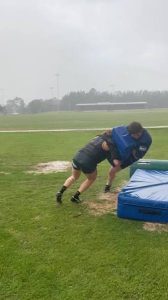
- Controlled contact against pads
- Static tackle positions
- Low-intensity one-to-one contact
- Planned tackling drills
- Reactive contact situations
- Full training
- Competitive match exposure
Return-to-rugby rehabilitation should reflect the player’s position, level, injury and specific match demands. A prop returning to scrummaging may require a different progression from a winger preparing for high-speed tackles and ball carries. (PMC)
When Is a Player Ready to Return to Rugby?
Time alone should not determine readiness.
Research on return to sport after shoulder injury recommends a staged process: return to performance rehabilitation, then controlled practice, unrestricted practice and finally competitive participation. (PMC)
Before returning, the player should normally demonstrate:
- Minimal or no pain
- No feeling of instability
- Appropriate shoulder movement
- Restored pressing and pulling strength
- Good rotator cuff and shoulder-blade control
- Confidence during falling and contact
- Ability to tolerate rugby-specific training
- Successful completion of a graded contact programme
- Medical or surgical clearance where required
Simple limb-symmetry percentages can be useful, but they should not be the only criteria. The injured shoulder must be sufficiently strong for the demands of rugby, not merely similar to a weak uninjured side.
Can Rugby Shoulder Injuries Be Prevented?
Not every collision injury can be prevented. However, physical preparation and good tackling technique can improve a player’s ability to tolerate contact.
The RFU’s Activate programme is an injury-prevention exercise programme designed for rugby. It incorporates balance, strength, agility and movement-control exercises and can also support rehabilitation after injury. (England Rugby)
Useful prevention strategies include:
- Regular shoulder and upper-back strength training
- Progressive exposure to contact before the season
- Maintaining rotator cuff capacity
- Developing trunk and neck strength
- Learning effective tackle technique
- Managing gym, training and match loads
- Completing a structured warm-up
- Fully rehabilitating previous shoulder injuries
Previous instability should not be ignored. World Rugby’s reported recurrence figure of approximately 35% demonstrates the importance of completing rehabilitation rather than returning as soon as pain improves. (World Rugby Passport)
Rugby Shoulder Physiotherapy at TA Physiotherapy
At TA Physiotherapy, we assess and rehabilitate rugby players ranging from recreational and school-level athletes to experienced competitive players.
Your programme may include:
- Detailed shoulder assessment
- Strength and stability testing
- Individualised gym rehabilitation
- Contact preparation
- Position-specific return-to-play planning
- Communication with coaches or medical teams
- Referral for imaging or orthopaedic assessment when necessary
Appointments are available at our clinics in:
- Henley-on-Thames at Badgemore Park Golf Club
- Crouch End
- Marylebone
Book a Rugby Shoulder Injury Assessment
Shoulder pain, instability or weakness can affect tackling confidence, gym training and overall performance.
Whether you are recovering from a dislocation, AC joint sprain, rotator cuff problem or post-operative shoulder stabilisation, structured rehabilitation can help you rebuild the capacity required for rugby.
Book a rugby shoulder injury assessment with TA Physiotherapy and start a clear, criteria-led pathway back to training and competition.
References
- World Rugby Passport. Dislocations: Shoulder injuries in rugby and immediate-care guidance. (World Rugby Passport)
- Leahy TM, et al. Epidemiology of Shoulder Injuries in Schoolboy Rugby Union. 2021. (PMC)
- Papalia R, et al. Rugby and Shoulder Trauma: A Systematic Review. 2014. (PMC)
- Sclafani MP, et al. Return to Play Progression for Rugby Following Injury to the Lower Extremity: A Clinical Commentary and Review of the Literature. The principles described include position- and demand-specific return-to-rugby preparation. (PMC)
- Wilk KE, et al. Return to Sport Participation Criteria Following Shoulder Injury: A Clinical Commentary. 2020. (PMC)
- Rugby Football Union. Activate Injury Prevention Exercise Programme. (England Rugby)
Can I play rugby with a shoulder injury?
A player should not continue if the shoulder is unstable, significantly painful, weak or unable to move normally. Traumatic injuries should be assessed before returning to contact.
How long does a rugby shoulder injury take to heal?
Recovery varies considerably according to the diagnosis and severity. A mild sprain may improve within weeks, while dislocations, major AC joint injuries or surgery can require several months of rehabilitation.
Does every rugby shoulder dislocation require surgery?
No. Management depends on age, recurrence, structural damage, playing level and instability. An orthopaedic specialist can advise whether surgical or non-surgical management is most appropriate.
What should rugby shoulder rehabilitation include?
Rehabilitation should restore movement, strength, stability, contact tolerance and confidence, followed by a staged return to rugby training and competition.